Honored Moments at Al Dhafra Date Festival & Auction
The vast desert of Abu Dhabi’s Al Dhafra region once again became the stage for cultural heritage, tradition and innovation. Among this year’s highlights, the festival — held under the patronage of His Highness Sheikh Hamdan bin Zayed Al Nahyan — welcomed distinguished guests and featured moments that underscored the wider significance of olive-oil culture alongside the date-palm traditions.
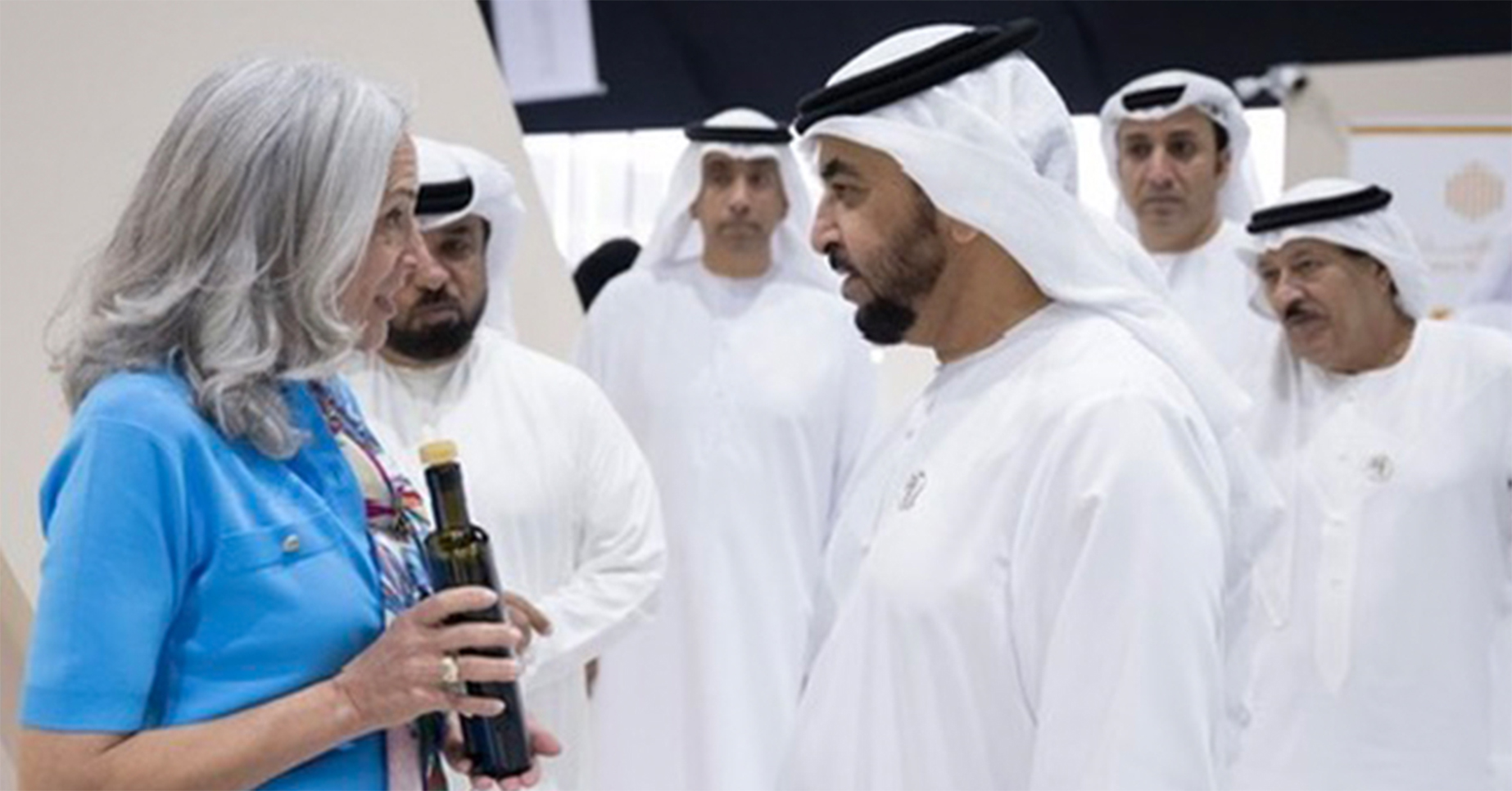
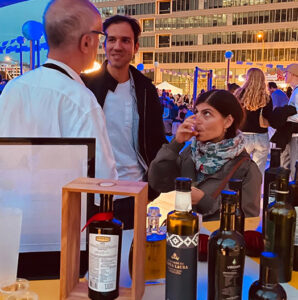
At the heart of the event stood a symbolic gesture: the presentation of an Argentine extra-virgin olive oil, one of the laureates of Olio Nuovo Days, acting as a link between hemispheres, civilisations and flavours. The festival, organised by the Abu Dhabi Heritage Authority, provided the backdrop for discussions around quality, authenticity and traceability in olive-oil production.
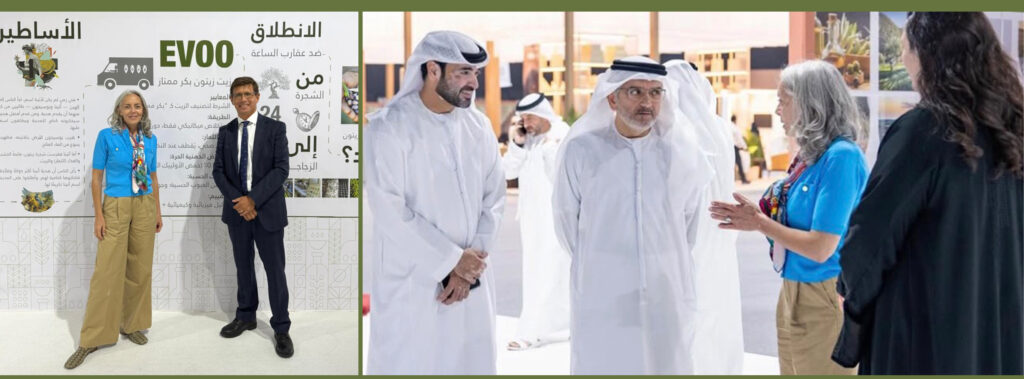
Educational engagement also featured prominently. A bilingual (English & Arabic) cultural timeline — tracing olive-oil production from its origin and the beginning of its cultivation in the Levant — was introduced, aligning ancient agrarian roots with modern labelling requirements such as variety, region, harvest date and method of extraction. The timeline emphasises that olive oil is not merely a culinary commodity but a living heritage.
Emmanuelle Dechelette, Sheikh Hamdan bin Zayed Al Nahyan at Al Dhafra Date Festival & Auction 2025
OLIVE TREE DIPLOMACY
During the festival Ms Dechelette met H.E. Emilio Pin Godos, Ambassador of Spain to the UAE, to discuss the journey of the olive tree. She later met H.E. Rashed Abdulkarim Al-Balushi, Executive Director of the Abu Dhabi Global Registration Authority, where the conversation centred on the core values of quality, authenticity and traceability.
His Excellency Emilio Pin Godos Ambassador of Spain in UAE, 2025 and His Excellency Rashed Abdulkarim Al-Balushi, Executive Director of the Abu Dhabi Global Registration Authority, 2025
CONTINUING THE JOURNEY: FOUR SEASONS OF LEGACY AND RELIABILITY
This marks the fourth consecutive year that Emmanuelle Dechelette has been invited to the festival, reinforcing the ongoing link between Olio Nuovo Days and the region’s commitment to institutional heritage and agricultural excellence.
Visitors and professionals alike were reminded that each drop of a quality extra-virgin olive oil carries tradition, terroir and trust — and that public education remains key to unlocking its full value.
With gratitude to Shawati Magazine, the Abu Dhabi Heritage Authority and Turathuna AE for their roles in celebrating this rich and enduring tradition.
THE OLIVE TREE’S CRADLE
Studies reveal that the wild olive tree and its cultivated forms exhibited significant genetic differentiation within the Mediterranean basin, reflecting three major refuges: the Near East (Levant), the Strait of Gibraltar, and the Aegean region. Although wild forms were present in multiple zones, the Levant is firmly identified as the primary cradle of domestication of the olive tree. Between the Mediterranean and Mesopotamia, the Fertile Crescent provided ideal conditions: rich river valleys, a mild climate and a remarkable diversity of wild species — wheat, barley, lentils and wild olive trees. As early as 10,000 B.C., communities in the region began to domesticate plants and animals. Located at the crossroads of Africa, Asia and Europe, this region gave rise to the first villages, first granaries and earliest agricultural societies. And it was here that humankind first learned to cultivate the earth — giving rise to the civilisations that shaped the Mediterranean world.
Moreover, olive trees have long been valued in more arid and marginal lands because of their relative drought tolerance — they demand far less water than many other crops, and thus became a smart choice for cultivation in zones where water was limited and other plants struggled.
Olio Nuovo Days au Festival du Monde – 20 & 21 septembre 2025
À l’occasion du Festival du Monde, Olio Nuovo Days vous propose deux journées de découvertes, de dégustations et de rencontres autour de l’huile d’olive.
Guidés par :
Emmanuelle Dechelette, fondatrice d’Olio Nuovo Days,
Marcelo Scofano, sommelier en huile d’olive venu du Brésil,
Christophe Lavelle, chercheur CNRS – Muséum national d’Histoire naturelle
Vous serez invités à explorer l’univers sensoriel de l’huile d’olive à travers des dégustations comparatives, des Master Class et des échanges avec des producteurs passionnés.
Le programme
Samedi 20 septembre – Déguster et comprendre l’huile d’olive – Master Class
Initiation à la dégustation : apprendre à reconnaître les arômes, les fruités et les défauts.
Goûter l’huile d’olive comme un sommelier et découvrir comment bien la choisir et la conserver.
Rencontre exceptionnelle avec la productrice italienne Marina Gioacchini, venue partager son savoir-faire et son huile d’olive LE AMANTINE de Tuscania, Latium.
Discussions autour des bienfaits santé et des usages culinaires avec Christophe Lavelle.
Paris, January 13th – Following her successful tenure as President of the OLIO NUOVO DAYS competition for the Southern Hemisphere, celebrated pastry Chef Jessica Préalpato has been appointed to the same prestigious role for the upcoming Northern Hemisphere competition. This marks a significant return for Chef Préalpato, who will once again lead the esteemed international jury in evaluating the finest extra virgin olive oils from across the globe.
The OLIO NUOVO DAYS competition celebrates the highest quality of freshly harvested olive oils, showcasing the unique flavors and aromas of the new season. As President, Chef Préalpato will bring her unparalleled expertise and discerning palate to the judging process, ensuring that only the most exceptional oils are recognized.
“I am thrilled to return as President of the OLIO NUOVO DAYS competition, this time for the Northern Hemisphere,” said Chef Préalpato. “My experience leading the Southern Hemisphere competition was incredibly rewarding, and I am eager to continue championing the excellence of extra virgin olive oil and contribute to the celebration of this incredible culinary treasure.”
Chef Préalpato’s appointment reflects her profound understanding of flavor profiles and her ability to discern subtle nuances. Her unique perspective comes from her concept of “Desseralité“, a mixture of dessert and Naturalité,” explains Préalpato. “And this word perfectly describes my pastry. The French word “Naturalité’” indicates something that belongs to nature and it is this basic “ to preserve an ingredient’s most beautiful “Naturalité’”, in order to create the best expression of its innate qualities”..
These are desserts with a raw visual; on the plate, everything must have a meaning.” Although simple at its core, when put into practice, the philosophy provides a challenge – but not one so big that Préalpato shies away from it.
Paris, February 5th – Following her successful tenure as President
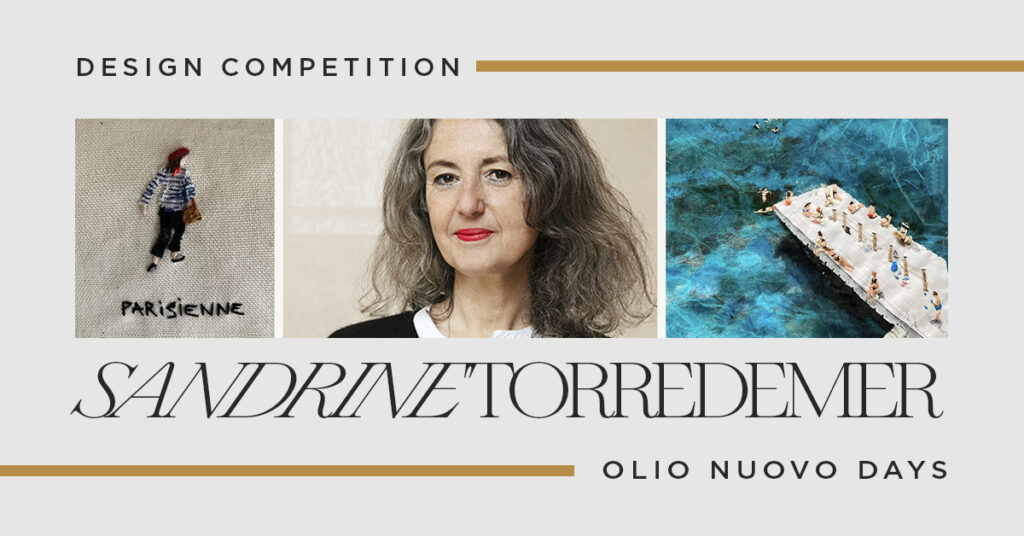
Paris, France – The prestigious Olio Nuovo Days design competition, celebrating the artistry of packaging for newly pressed olive oils, is delighted to announce a dual role for renowned artist Sandrine Torredemer, known online as @la__filature. Torredemer will not only chair the esteemed judging panel for this year’s competition but also create an original artwork inspired by the winning design, further elevating the award’s prestige.
Olio Nuovo Days seeks to recognize innovative and visually compelling bottle and packaging designs that embody the essence of “olio nuovo” – the vibrant, intensely flavored early harvest olive oil. This year’s competition takes on added significance with Torredemer’s involvement, bringing her discerning eye and artistic vision to the forefront.
@la__filature is a multidisciplinary artist celebrated for her captivating works that explore the interplay of nature, texture, and light. Her distinctive style, characterized by renewing the art of embroidery, delicate lines, use of natural materials, evocative imagery, makes her uniquely qualified to lead the jury in selecting a design that resonates with both aesthetic excellence and the spirit of olio nuovo.
“We are honored to have Sandrine Torredemer chair this year’s Olio Nuovo Days design competition,” says Emmanuelle Dechelette, founder of the the Olio Nuovo Days. “Her profound understanding of art, design, and the evocative power of objects makes her an ideal leader for our jury. Furthermore, the original artwork she will create based on the winning design promises to be a truly exceptional and lasting tribute.”
As chair of the jury, Torredemer will guide the panel in evaluating submissions based on criteria such as originality, functionality, visual impact, and connection to the values of Olio Nuovo Days. Her expertise will be invaluable in identifying a design that not only stands out aesthetically but also effectively communicates the unique qualities of the featured olive oil.
Beyond her role as chair, Torredemer will also create an original artwork inspired by the winning design. This piece will serve as a unique artistic interpretation of the design’s core elements, adding a layer of artistic dialogue and further celebrating the winner’s achievement.
About Torredemer
Introduced to embroidery at an early age by her grandmother, Sandrine TORREDEMER has never stopped embroidering, a passion that became almost a necessity when her life was turbulent. Her artistic approach has gradually freed itself from the technical constraints of traditional embroidery to become less academic, less perfect, more personal and more sensitive. She draws most of her material from her family heritage, embroidering on discarded and patched sheets, with old canvas threads that she completes with mini-stitches of clothing she’s found at thrift shops, bits of nothing gleaned to give them a new life. This recycling gives the embroidered works their unique character, which resonates with our environmental concerns. Beyond recycling, embroidery responds to today’s aspirations for an art form that takes the long view, at odds with instantaneity and super-production, a form of luxury in the slowness of creation.This second life given to materials is also hers since she gave up her first professional activity to devote herself exclusively to embroidery. From her background in urban planning, she has retained a certain eye for urban forms and architecture, which she reproduces in small touches, sometimes insisting on attention-grabbing details.
The announcement of the winning design and the unveiling of Torredemer’s artwork will be a highlight of the Olio Nuovo Days event in Paris on March 26th. The event will bring together producers, designers, and enthusiasts to celebrate the exceptional flavors of new olive oils and the creativity behind their presentation.
Like many other countries of the Mediterranean, olive oil is an important staple in Lebanon. As a small olive-producing country with a modest production, it gets less attention than the big producers. But this is where olive production began and the olive tree has its origins. The olive tree is native to Lebanon and has been growing here for thousands of years.
Home to the world’s oldest cultivar
The dominant olive variety growing in Lebanon is Souri, which is also endemic to other countries of the Middle East, including Jordan, Israel and Palestine. Considered to be one of the oldest olive cultivars in the world, it is said to have originated from the southern Lebanese city of Tyre (also known as Sour). This is a ‘dual-purpose cultivar’ used for table olives as well as olive oil, and has a high oil content.
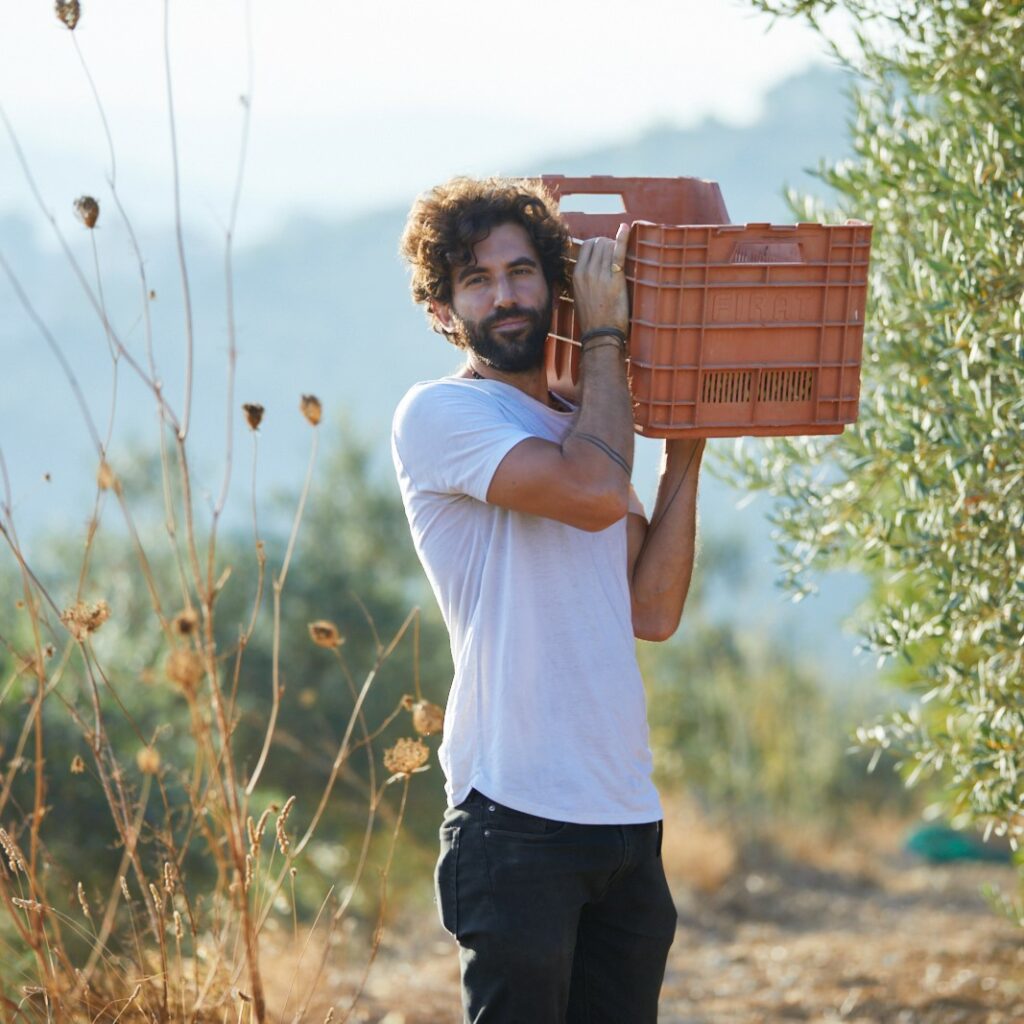
Harvest with SOLAR
There are close to a dozen different cultivars growing across the country, with the second most common being Baladi, while other notable ones include Ayrouni, Shami, Shetawi and Smoukmouki.
Production facts and figures
Figures shared by the Lebanese Ministry of Agriculture reveal that between 15,000 and 25,000 tonnes of olive oil are produced in Lebanon each year, of a which a quarter is extra virgin olive oil. Less than ten per cent of the total production is exported to other countries. There are about 400 olive mills located across the country.
Karim Arsanios is the fourth generation to inherit his family’s 1600 olive trees spread over three to four hectares in the remote village of Kour in northern Lebanon. Sharing the property with 200-year-old olive trees is a traditional stone house that has been in the family since the mid-19th century.
After a career in finance, followed by a stint in the US where he studied sustainable management, Arsanios returned to Lebanon for family reasons and since then has been taking care of his ancestral olive trees and producing high-quality extra virgin olive oil. This is in addition to working as a professional chef, two professions which complement each other.
“It’s a tree that has been around for millennia,” he says of the olive tree. “It’s one that has references in the Bible and the Koran. It symbolises peace but is also a tree that has helped the economy and people survive. Its olives, oil and wood have had many different uses. The olive tree has always been very generous and there’s a proverb by a poet that says that if you travel across the Middle East, there will always be an olive tree to provide you with shelter. It’s a tree that has given a lot to the people and for this reason people have a lot of respect for the olive tree.”
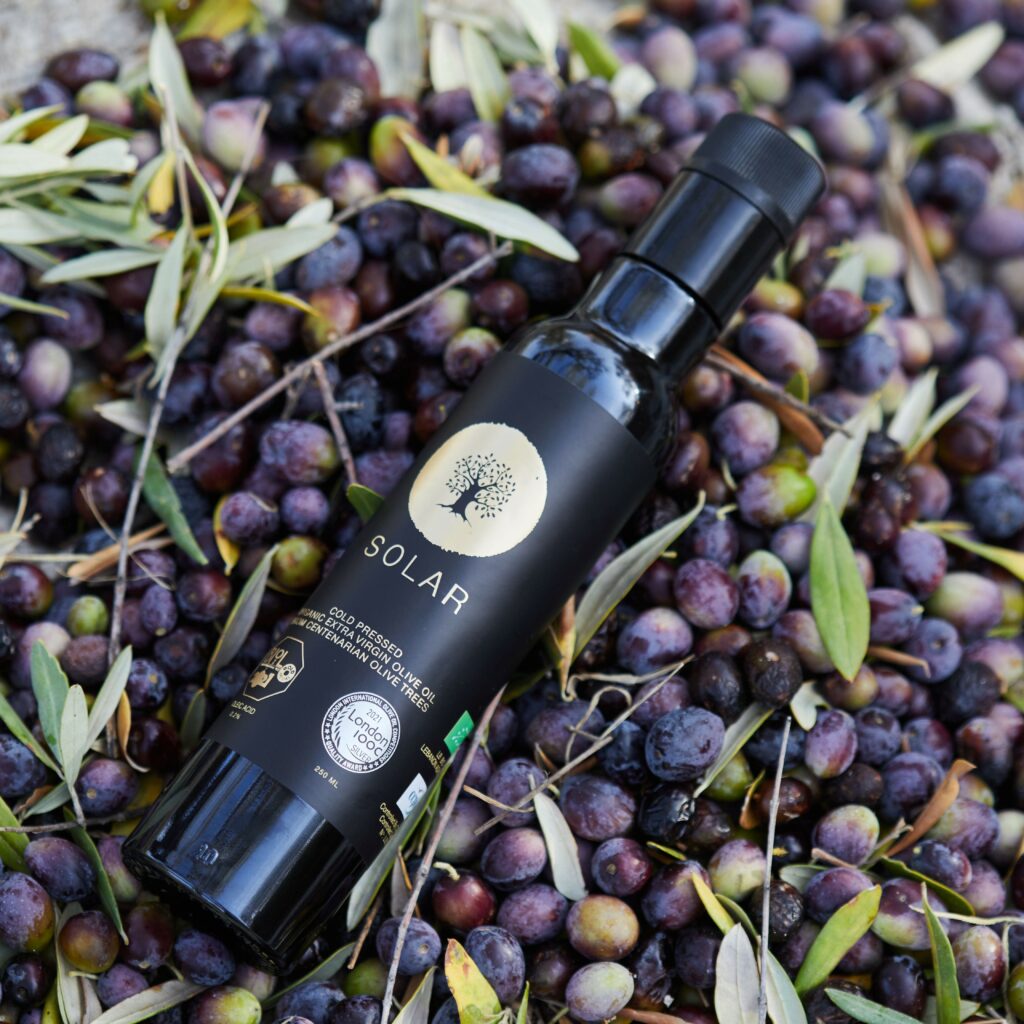
SOLAR EVOO Lebanon
On his olive farm, production methods follow organic principles. Pesticides are eschewed, and compost is used instead of fertiliser. Though such methods can mean lower yields, the goal for Arsanios is a quality end product. “We don’t spray anything on the trees and as a result we lose about 15 per cent of our crop,” he says. “This is a significant amount. But we simply let nature do its work and don’t intervene, so it’s a kind of biodynamic approach. We get visits from chickens from the farms next to us who provide natural fertiliser.”
Arsanios’ organic extra virgin Souri monovarietal, Solar, has been recognised for its high quality with awards from several international olive oil competitions. “I would say that there’s a lot of pepperiness,” he says of its taste profile. “It’s tangy, it’s bitter, it’s very grassy. When its first pressed, it smells like green tomatoes. When it’s heated up, it has sweeter notes.”
While producers in Lebanon haven’t faced the drought conditions experienced by other parts of the Mediterranean last year, changing weather patterns are a growing concern. “There have been lots of ups and downs in recent years,” says Arsanios. “It’s hard to predict how the next harvest will be. Our soil is pretty good for water retention and we’re next to a mountain water source so we don’t have to worry about drought. But now because of extreme weather events I’m a bit worried. For example, in January we had a week of 25 degree temperatures which is unusual. I don’t know how the trees will react and I’m already thinking of how to adapt in the future.”
The country’s ongoing economic crisis is perhaps posing the biggest challenge for Lebanon’s olive producers. Financial assistance from the government has evaporated, and increasing energy costs have driven up the cost of production. “We’re dealing with high energy prices and crazy inflation,” shares Arsanios. “And it’s a challenge to find enough workers. This instability is a challenge for small producers who are trying to take care of the land and may eventually put this industry in jeopardy.”
Lebgenco Olive Oil: Showcasing all of Lebanon’s unique flavours
Located in Baassir on the slopes of Mount Lebanon is Domaine du Bey, a centuries-old olive grove that’s been in Ibrahim Al Kaakour’s family for eight to 10 generations. “In Lebanon almost everyone produces olive oil or has a family member or neighbour who does. Olive oil is part of our identity and it’s something to be proud about,” says Al Kaakour of his country’s long tradition.
LEBGENCO Ibrahim Al Kaakour
His groves are made up of the native olive varieties of Souri and Ayrouni, with about thirds of the trees being of the Souri variety. “Souri is a very special cultivar,” he says of this native varietal. “It has a different profile from European cultivars and is one of the oldest cultivars in the world. It’s very nutty and very earthy, with a lot of notes of artichoke, pine nuts and black pepper. It pairs well with red meat, beans and yellow cheeses. It’s very different from Italian and Greek cultivars which are very fruity in general. If you use a European cultivar on Lebanese cuisine, it just doesn’t work. Our food calls for nutty, earthy, peppery profiles which you don’t find often in European cultivars.”
What started as a family business has now expanded with the creation of Lebgenco Olive Oil of which Al Kaakour is the founder and owner. Today the company is the most awarded brand in Lebanon with close to 80 products on offer. “We’re expanding because we have a lot of interest in our products,” says Al Kaakour. “Our focus now is on creating blends. This makes us the first blenders to work with Lebanese cultivars. We cultivate and buy varieties from several areas of the country and we’re the only ones who offer all the aromas that Lebanon has to offer, and all flavour profiles: low, medium, intense, fruity, earthy.”
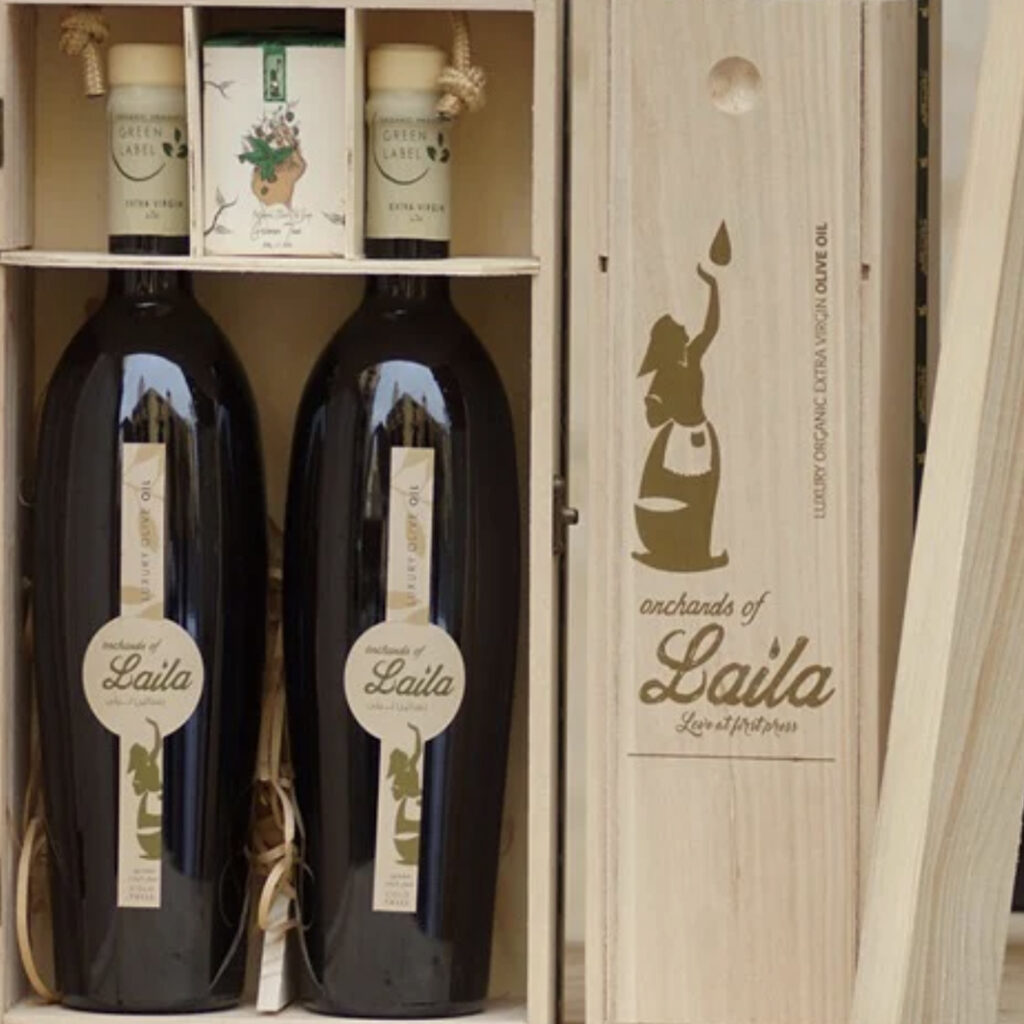
ORCHARDS OF LAILA by LEBGENCO
Also on offer are olive oils infused with special flavours, with the most unique one being cardamom olive oil. The company has also added olive oil based cosmetics made with local ingredients and essential oils. Lebgenco’s products are currently available in the Czech Republic and Belgium, and soon in Austria.
With an eye on quality, the company is organic certified and uses only traditional cultivation methods. “But this makes the cost of production higher and our work more difficult,” Al Kaakour points out. “However the economic crisis is our biggest challenge. Companies need financing to grow and this is something we don’t have any more. Also because of the lack of government support we don’t have the tools to fight the fruit fly or diseases like peacock spot. And many lost money when the banks defaulted and had to restart from scratch.”
“I compare the olive tree to the Lebanese people,” he adds. “They say you are what you eat, and the olive tree is very resilient, at least the cultivar that we have is very resistant to heat, arid conditions and lack of water. The Lebanese are also very resilient. If you cut an olive tree, it grows back. We have the same traits. We’ve been through a lot but we still manage to rise again, like the phoenix.”
When choosing an olive oil, a consumer has to rely on the information found on the bottle as well as the messages communicated by its label and packaging. A customer who’s unable to sample a product before purchasing it will judge it by what they can see.
A label should ideally reveal whether the olive oil is a monovarietal or a blend, its origin, and harvest date, etc. Meanwhile, the brand’s visuals, including the bottle, are what catch the eye. The design of these visuals can hint at the story behind the product, give an impression of its value and quality, and evoke emotions that ultimately persuade a purchase.
Design is communication
“Design is communication. Just like a writer chooses their words to communicate a message, good designers choose the right visual elements to also communicate a message,” says Carlo Angelini of Angelini Design, an Italian brand consulting and communication agency with offices in Paris, Rome, Torino and Shanghai that has worked on the branding and design of several high profile olive oil producers, as well as the visual identify of Olio Nuovo Days.
“When it comes to packaging, design is crucial,” he adds. “From the packaging you can tell the brand essence of a product, and understand what kind of brand it is, what kind of position it has and also its initial experience. The packaging is branding. It says who you are, what kind of brand you are. It’s a way to talk with the customer.”
When working with clients, Angelini’s process involves studying the visual as well as emotional layers of the brand to come up with a strategy that will be converted into a visual language. When it comes to the emotional layer, this refers to the feelings that are conveyed with the design and which hint at the quality of the product.
Transmitting emotions
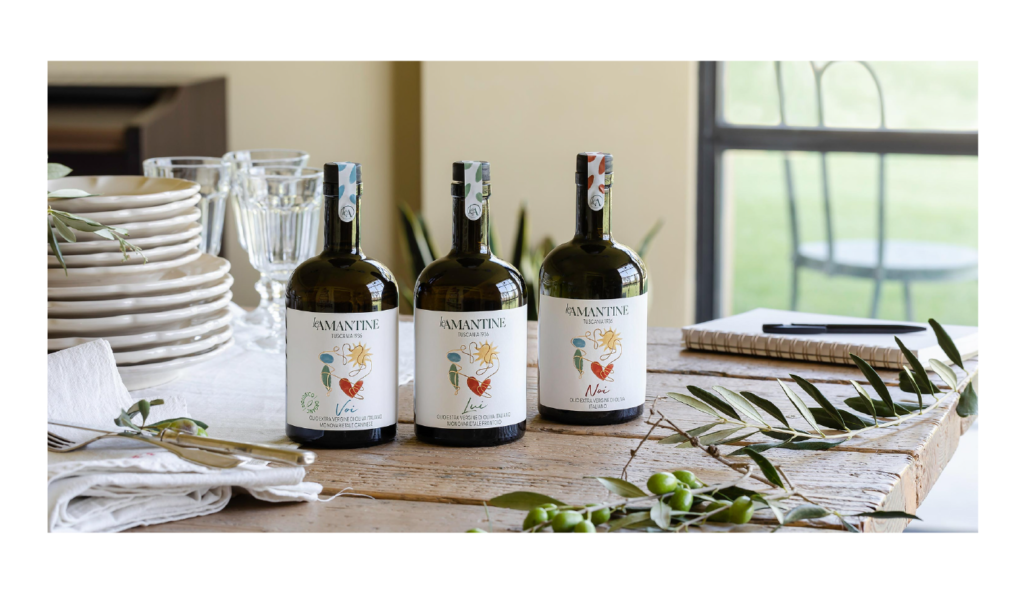
For Italian olive oil producer Marina Gioacchini, feelings and emotions were vital to the rebranding process when she was working on creating a new visual identity for her brand Le Amantine last year. “I’m a very emotive and sensitive person who’s sensitive to art, so the new visual identity for Le Amantine was important to me,” says Gioacchini. “A label can immediately transmit an emotion and a message about the person who’s behind the product. It’s like a visiting card, but a lot more than that because it can transmit an emotion. Using visuals, I wanted to tell my story, one that’s based on the feelings and emotions that represent my olive oil business.”
Gioacchini worked with Verona-based graphic designer Massimo Pagliarin, a graduate of the reputed art academy Accademia di Belle Arti di Brera, to come up with a new design for Le Amantine. “For me it was essential that the visuals communicate that it’s an Italian product. And of course that it’s a quality product, an olive oil of high quality. And we had to find a way to mention transmission and love. These two words kept coming back.”
Her olive groves in Tuscania, located in the Lazio region north-west of Rome, were planted by her grandfather, inherited by her father, and eventually passed on to Gioacchini. Hence the idea of the ‘transmission’ of family heritage, but also of values. “And love,” she adds, “because this work is a labour of love. You don’t make money from it. You put your whole heart into it.”
The new visual features stylised symbols of a sun, heart, olive fruit and olive leaf, connected via a golden thread representing family ties but also the continuity between the past and future. The soft, natural colours of each symbol hint at those of the local landscapes. “The soft pink of the heart is the colour of facades in Italy, while the blue olive was the suggestion of the artist,” shares Gioacchini. “I thought it should be green but he suggested blue because it opens up an imaginary world. Actually the olive grove is situated between a magnificent lake and the sea, so I liked this surrealist touch the blue olive gives.”
A label tells a story
Spanish producer Marina Segura wanted to tell the story of her family’s brand Peña Luna and its origins via the packaging of their monovarietal olive oils. It was her grandfather who first produced olive oil from the family’s trees in Seville and Malaga provinces. After his death, the family decided to build the company in his honour, and Peña Luna was born.
The striking black and white illustrations created by Spanish visual artist Isabel Cabello of Cabello x Mure capture the eye. At the same time they tell the story of the ‘legend’ of Peña Luna through a series of five images decorating the bottles containing the brand’s five monovarietals.
“The story behind the packaging is a mix of fantasy and reality,” says Segura. “It’s a story that was created by our family, and inspired by our grandfather. It’s based on the lands where our grandfather lived and tells the story of a young woman who’s in a moment of her life where she feels a bit lost. Her grandfather appears to her and gives her a vision that he’s there for a reason and the reason is to take care of his family and her loved ones by growing trees on their lands and making a good oil.”
Keeping it simple
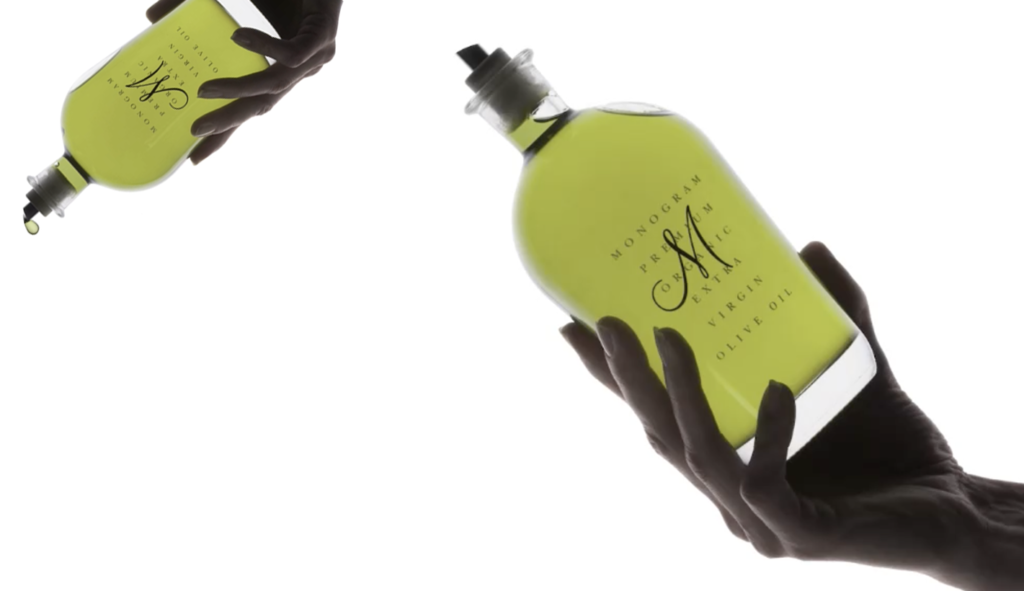
For Anastasis Magganas, producer of Monogram extra virgin olive oil from Greece, the approach to packaging was to keep things simple, while communicating vital information about their products. “Our philosophy regarding the packaging is based on olive oil tasting and olive oil pairing,” says Magganas. “We want our customers to be fully informed about the product they are buying, that’s why we are focusing on the text and information on the front side of the packaging of each of our monovarietal olive oils.”
The brand’s striking typographic design stands out, while the elegantly shaped bottle and its stopper are pleasing to the eye. The aim of the design concept was to create a sense of harmony that would emphasise the well-balanced flavour of the product.
“The goal was to give as much targeted information to the consumer as possible,” adds Magganas. “Our idea was to simulate the packaging with a book, where the front of the packaging contains the book’s contents, in the same way that the consumer flips through a book, so that on each side of the box he can read the text with the information and history of each olive oil.”
It’s in the bottle
When it comes to olive oil, the bottle is an integral part of the packaging that not only protects its contents but can also convey a subtle message. It’s an important visual element that identifies a brand while also being tactile. Its weight and shape give a certain feel when held in the hands, and can add a decorative touch to a dining table.
A classic bottle shape with squared edges is the most common one seen in supermarkets and is associated with industrial olive oils produced for the mass market. This is why producers aiming to give their brand a more premium feel, look for a unique bottle shape that stands out.
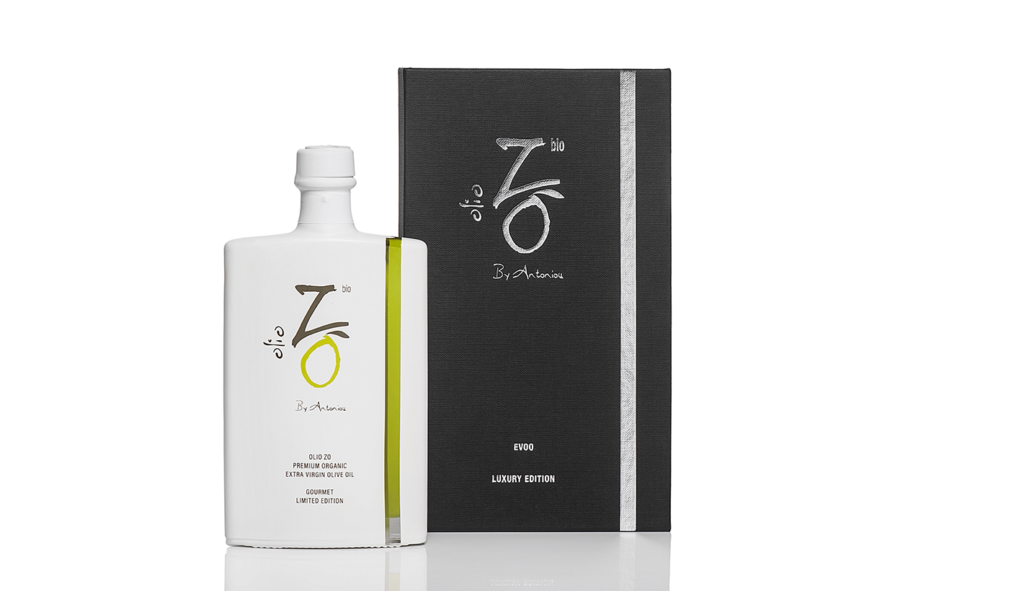
For the Cypriot producers behind Olio Zo, the brand’s distinctive bottle is an important part of its visual identity. “The design of a bottle is important because the quality goes with the bottle,” says Andri Adamou. “The whole packaging is important and the bottle is part of it. The bottle we chose is flat, which is unusual for an olive oil. But it stands out and makes it ideal as a gift.”
The bottle used for their premium Olio Zo extra virgin olive oil was made in Italy, and hand-painted in Greece according to a design imagined by Adamou and her producer husband, Antonis. “We met many designers but didn’t really like anything so we decided to design it ourselves. We wanted a bottle that preserves the quality of the olive oil while letting you see its colour.”
The bottle is painted in white, with a vertical transparent line through which the colour of the olive oil is apparent. At first glance, this green line looks like it’s been painted. “By looking at our bottle, the buyer should understand that they’re getting something special – inside and outside,” adds Adamou. “This is an expensive product. People have told us to make another bottle that’s cheaper, and leave this design as a luxury product. But we prefer to have this bottle because it’s our identity. It takes hard work to make a premium high quality olive oil and this is reflected in the design of our bottle.”
A design prize at Olio Nuovo Days 2023
Design is an award category that’s been added as a feature of many olive oil competitions in recent years. At Olio Nuovo Days 2023, in addition to prizes for Best Extra Virgin Olive Oil, Best Pressed-Infused Olive Oil, and Health Claim, entries will also be judged for their visuals and packaging with a special prize awarded to the olive oil brand with the best overall design.
A special design panel of 11 professionals is tasked with judging entries and awarding the coveted design prize. Leading the panel is Valérie Maltaverne, founder of the art furniture and design firm YMER&MALTA, and recipient of the title Chevalier des Arts et des Lettres by the French government in recognition of her contribution to the survival of traditional French crafts.
“The design prize is just as important as one for quality,” says Maltaverne. “When choosing a product, you tend to select one with a design that appeals to you. This is part of the art de vivre. Olive oil for me is a luxury, it’s like a good bottle of wine. You don’t know what the taste will be like so the bottle is the first impression you have. Its shape, colour and label should relate to the brand, and there should be a strong visual identity, and at the same time a decorative aspect which adds to the aesthetics of the table.’
The Olio Nuovo Days design jury will be judging entries according to a range of criteria aiming to appraise a brand’s design, practicality, visual identity, informational details, originality and overall impression.
The world’s best olive oils are coming to Paris again this March during the 7th edition of Olio Nuovo Days. The Ritz-Escoffier School at the iconic Ritz Paris on place Vendôme will be the prestigious venue for this international olive oil competition taking place from March 22nd to 24th.
To join the Olio Nuovo Days Masterclass on March 24th, register your interest by contacting Olio Nuovo Days at north@olio-nuovo.com
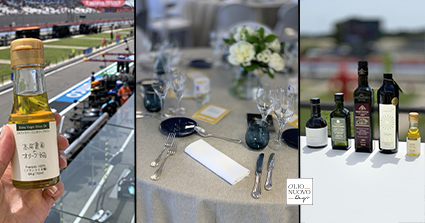
On June 18, 19 and 20, OLIO NUOVO DAYS was invited to the Emirates Grand Prix de France Formula 1.
An opportunity to introduce the best olive oils from both hemispheres to the guests in the VIP rooms.
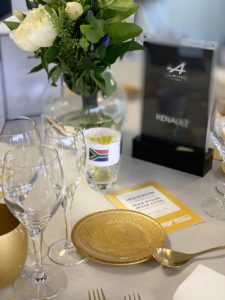
The guests in the Emirates, Rolex, Heineken, Pirelli, Ferrari, Alpine and Formula Experience boxes were able to discover the winning oils of the last OLIO NUOVO DAYS competitions.
An exceptional tasting both for the quality of the event and for the quality of the Extra Virgin Olive Oils presented:
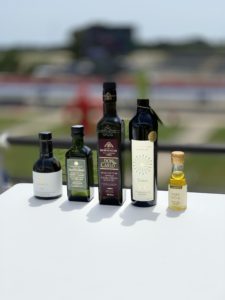
The South African Morgenster was extracted on June 1st and the Argentine Zuccardi on May 25th ….
Freshness, but also terroir, were in the spotlight with a comparative study of the Frantoio variety: Amantine, extracted in October in Italy and Takao, extracted in October in Japan… The same variety, two identities.
The 300 guests each day were conquered by these tastings carried out under the benevolent authority of Emmanuelle Dechelette (Paris), founder of the OLIO NUOVO DAYS, and Marcelo Scofano (Rio de Janeiro), ESTILO GOURMET chef oleologist.
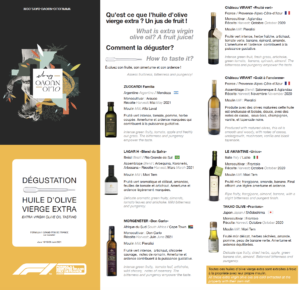
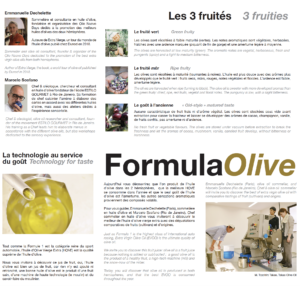
A programme in two languages, French and English, edited in 1000 copies, with the aromatic profiles was offered to the 900 guests.
OLIO NUOVO DAYS @ FORMULA 1 GP de FRANCE 2021 Le Castellet _4534
Les 18, 19 et 20 juin derniers, OLIO NUOVO DAYS était invité au Emirates Grand Prix de France de Formule 1.
Une occasion de faire découvrir les meilleures huiles d’olive des deux hémisphères aux invités des loges VIP.
Les invités des loges Emirates, Rolex, Heineken, Pirelli, Ferrari, Alpine, Formula Experience, ont ainsi pu découvrir en exclusivité les huiles lauréates des derniers concours OLIO NUOVO DAYS.
OLIO NUOVO DAYS @ FORMULA 1 GP de FRANCE 2021 Le Castellet _MORGENSTER IMG_4587
GRAND PRIX DE FRANCE 2021 Loge Emirates
Des jus d’une fraicheur extrême, La sud africaine Morgenster avait été extraite le 1er juin et l’Argentine Zuccardi le 25 mai….
La fraicheur, mais également le terroir étaient à l’honneur avec une étude comparative de la variété Frantoio : Le Amantine, extraite en octobre en Italie et Takao, extraite en octobre au Japon… Une même variété, deux identités.
OLIO NUOVO DAYS PRESENTATION at GP F1
Les 300 invités chaque jour ont été conquis par ces dégustations réalisées sous l’autorité bienveillante de Emmanuelle Dechelette (Paris), fondatrice des OLIO NUOVO DAYS et Marcelo Scofano (Rio de Janeiro), Chef oléologue ESTILO GOURMET.
Un programme en deux langues, français et anglais édité à 1000 exemplaire, avec les profils aromatiques ont été offerts aux 900 invités.
Culture d’olive et huile d’olive dans l’hémisphère sud : l’Amérique latine.
Par Jorge Enrique PEREIRA BENITEZ (Consultant international)
Jorge Pereira Benitez
C’est sur le continent Américain, au 16ème siècle, que l’oléiculture a été introduite pour la toute première fois en dehors de sa zone méditerranéenne d’origine.
Avec une superficie cultivée, une production et des exportations qui représentent respectivement moins de 3%, 2,5% et 5% du total mondial, le continent américain est néanmoins un acteur majeur du secteur oléicole avec des importations de près de 60% du marché mondial (Nord + Sud).
En mars 2020, le sous-continent sud-américain a été la première région de la planète à devoir s’adapter pour gérer sa campagne dans les conditions imposées par la pandémie de COVID 19. En 2021, pour la campagne en cours, les mêmes dispositions s’appliquent toujours
L’une des particularités géographiques de l’Amérique latine, est que la majeure partie de sa surface cultivée l’est en dehors de la «latitude méditerranéenne», située entre 30 et 40 degrés Nord.
Sur sa partie Ouest, pacifique, le courant froid de Humboldt, permet une adaptation climatique à des latitudes extrêmes, avec comme exemple de site de culture oléicole le plus septentrional, Leyva (Colombie) dans la province de Boyaca à 2200 mètres d’altitude et +5 degrés de latitude nord, oui, la Colombie se situe bien dans l’hémisphère Nord !
Les zones de productions les plus septentrionales
se trouvent en Colombie, à Leyva, dans la province de Boyaca à 2200 mètres d’altitude et +5 degrés de latitude (petite exploitation) et au Pérou, dans la région d’Ica 14,5 degrés de latitude sud.
La zone la plus méridionale
est localisée en Argentine dans la province de Chubut à -42 degrés de latitude sud
C’est également l’une des principales causes d’alternance entre les cycles de production “haut/élevé” et “bas/faible”. La récolte 2021 correspond à un cycle de production « haut » qui devrait atteindre 60000 tonnes, soit une augmentation de 20% par rapport à 2020, principalement en raison de l’importance de l’Argentine et du Chili qui produisent 52000 tonnes, soit 88% de la production du continent. Plus de fruits à récolter signifie allongement de la période de récolte, qui, combinée aux incertitudes liées au COVID 19 risque d’entraîner des difficultés dans les zones non mécanisées (environ 40% du continent).
Consommation d’huile d’olive par personne et par an :
C’est au Chili que l’on consomme le plus d’huile d’olive, avec 550 ml, viennent ensuite l’Uruguay avec 515 ml, et le Brésil, avec 460 ml. La moyenne pour l’Amérique du Sud est de 380 ml/personne/ an. L’Argentine, la Colombie et le Pérou se situent en dessous de la moyenne continentale avec respectivement 250 ml, 125 et 110 ml. La moyenne de consommation en Amérique du Sud est inférieure à la moyenne de consommation mondiale : 430 ml / personne / an, loin de l’Europe qui consomme en moyenne 2,3 L, l’Océanie 2 L et surpassant l’Afrique 220 ml et l’Asie 80 ml. Si l’on considère l’ensemble du continent nord, central et sud-américain, la moyenne s’élève à 1,34 litre / personne / an, principalement en raison de la consommation aux États-Unis.
EN ARGENTINE
L’Argentine est le plus grand producteur d’huile d’olive d’Amérique et l’un des dix plus grands au monde, a commencé sa récolte 2021 fin d’avril et devrait la terminer en juillet. L’importance des récoltes varie selon les région avec de grandes disparités, avec c’est San Juan, au nord-ouest du pays, qui est l’une des provinces leader.
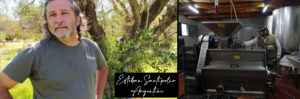
Esteban Santipolio ARGENTINE
Esteban Santipolio (Pocito, San Juan), ingénieur agricole diplômé de troisième cycle en agro-commerce, développement rural, élaiotechnique et agroécologie, développe dans la ville de Pocito, au Nord de l’Argentine, près de San Juan, un projet agroécologique sur 8 hectares d’oliviers centenaires de 9 hectares et de nouveaux oliviers sur 10 hectares des variétés Arauco, Arbequina, Picual et Coratina. Esteban a décidé d’industrialiser ses récoltes en 2021, avec pour estimations une production de 750 tonnes d’olives, soit près du double de 2020. Il souligne également que lors des bonnes récoltes, il produit 1200 tonnes, malgré un rendement huile / olive inférieur de -3-4% à celui des récoltes précédentes indifféremment de la variété.
Dans la région de production de La Rioja, à Chilecito, centre oléicole très important, la production d’olives a diminué de 75%, avec un rendement inférieur. Dans ce contexte de production productif, les prix de vente ont été meilleurs que les années précedentes, à 3 500 euros la tonne d’huile. La production se réparti en 15 tonnes d’huile d’olive vierge extra « haut de gamme » en bouteille, le reste en vrac.
FAMILIA ZUCCARDI
À Mendoza, autre importante région de production, Miguel Zuccardi, responsable de la division oléicole de « Familia Zuccardi », producteur des gammes « Zuelo » et « Premium Familia Zuccardi », évalue que la nouvelle campagne comme excellente en qualité et en quantité. Les conditions climatiques ont été favorables, avec un été relativement frais dont le résultat a été une bonen quantité de fruits, avec cependant une maturité tardive. Au pied des Andes, le climat est désertique et continental, avec un risque de gelées à l’automne, phénomène que la famille ZUCCARDI n’a pas encore eu à déplorer. Arauco, la variété emblématique de la maison est cette année un très bon se réjouit Miguel Zuccardi. Parmi les autres variétés, Coratina se distingue avec beaucoup de notes aromatiques et une belle complexité.
De façon globale, la récolte en Argentine a été moyenne, à relativiser selon les régions. Les oliveraies modernes (intensives et super intensives) ont eu une productivité très élevée favorisant l’expansion de l’oléiculture à Mendoza et dans d’autres régions, il est à noter que cette année le taux d’huile d’huile dans les olives était relativement faible.
Au cours des 20 dernières années, l’Argentine a beaucoup progressé dans son expertise oléicole, elle a su adapter aux différentes zones climatiques pour en tirer le meilleur au niveau rendement et sensoriel. Pour exemple, la diversification des régions oléicoles avec de nouvelles zones aux microclimats maritimes à le sud-ouest du pays, comme la Patagonie, favorisant la diversité des huiles de haute qualité.
La hausse des prix de l’huile d’olive au niveau international est une bonne nouvelle pour la production, offrant une reconnaissance au travil complexe que représente la prodction d’huile d’olive.
AU CHILI
25 000 hectares de plantations, avec une prodction moyenne de 20 à 22 000 tonnes d’huile d’olive. La plupart en oliveraies sont en super-intensif, offrant au Chili le titre de pays ayant la plus grande efficacité de production au monde (près d’une tonne d’huile / hectare).
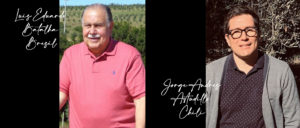
Jorge Andrés Astudillo Ingénieur agronome réputé, conseiller dans de nombreuses régions du Chili nous explique que la campagne 2021 a commencé avec deux semaines de retard (habituellement vers le 20 avril) en raison du manque d’eau et de froid, ce qui a retardé la maturation. Les rendements (huile / fruit) ont augmenté, passant de 14% à près de 18,5%. Ce retard a affecté différemment les variétés, étant négatif pour Frantoio et positif pour Arbequina, qui a considérablement augmenté par rapport aux années précédentes.
IMPACT COVID19 : La pandémie a eu un impact majeur sur la main-d’œuvre traditionnellement fournie par les travailleurs de Bolivie et du Pérou : En raison de la fermeture des frontières ils n’ont pas pu venir travailler aux récoltes du Chili cette année. La récolte des olives de table sera la plus affectée puisqu’elle est intégralement manuelle. La récolte mécanique est aussi touchée par ce manque de main d’oeuvre : plus de temps será nécessaire à la récolte et les producteurs n’ayant pas leur propre moulin, doivent attendre leur tour plus longtemps pour transformer leur production ; Ces données seront à considérer en plus du démarrage tardif de la campagne. Le Chili envisage tout de même une production très qualitative.
AU PÉROU
L’un des pays de la côte Pacifique où l’on trouve le plus grand nombre d’oliviers centenaires avec l’essentiel de la production en olives de table.
Gianfranco Vargas
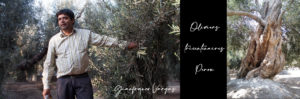
Gianfranco Vargas Flores, consultant oléicole et maître d’huilerie, confirme une récolte bien inférieure à celle de 2020, avec 180 tonnes d’olives pour tout le pays. Les exportations d’olives de table seront également inférieures à l’an passé, avec à peine 15 tonnes. L’activité a été compliquée par la hausse du prix des olives, tant pour l’huile que pour la table (40-50%), principalement en raison de la dépréciation de la monnaie et de l’augmentation des coûts liés à la pandémie de COVID19 qui a paralysé le mouvement des personnes.
EN URUGUAY
OLIVARES DE SANTA LAURA
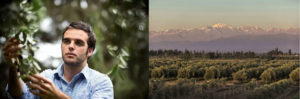
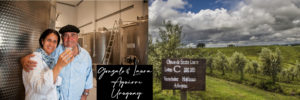
Gonzalo Aguirre est producteur au nord-est de l’Uruguay. Sa ferme agricole allie élevage, sylviculture et oléiculture. L’oliveraie occupe 95 hectares de la propriété avec des variétés telles que Arbequina, Coratina, Picual, Hojiblanca ou encore Manzanilla qui ont été plantées par étapes depuis 2012. La récolte de cette année a été la meilleure de son histoire, avec plus de 400 tonnes d’olives et près de 40000 litres d’Huile d’Olive Vierge Extra.
Et cependant le rendement n’a pas été bon, tout comme dans d’autres régions d’Uruguay, même si le producteur est convaincu qu’il faut miser de plus en plus sur la récolte précoce, malgré un rendement plus faible, en privilégiant toujours la qualité. « À l’avenir, j’aimerais transformer plus de fruits en moins de temps » commente Gonzalo Aguirre. Compte tenu du caractère familial de l’entreprise, le COVID n’a affecté ni la production oléicole ni le domaine.
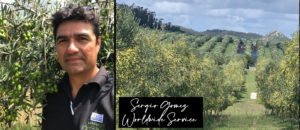
Sergio GOMEZ SERVICIO
Sergio Gómez, Ingénieur agricole à la réputation internationale : Argentine, Chili, Brésil, Espagne, Maroc et en Uruguay, est l’un des plus grands prestataires de services oléicoles. Son avis fait acte de foi dans le pays : « La récolte a commencé début avril et devrait durer jusqu’à fin juin, les prévisions sont une amélioration considérable de la production d’olives, 22 500 tonnes, avec un rendement moyen de 12%, La qualité vierge extra devrait s’approcher des 2200 tonnes; en 2020, il n’avait pas dépassé 300 tonnes. Loin des 2700 tonnes produites en 2019… »
Ce professionnel gère tout, depuis la plantation d’oliviers jusqu’à la récolte. Pour ce faire, il dispose d’un équipement important, et d’un personnel hautement qualifié et expérimenté, ce qui lui a permis malgré les limitations de mobilité dues à la pandémie de répondre aux besoins de ses nombreux clients. La récolte devrait être prolongée jusque début juillet 2021 selon lui.
Le marché intérieur Uruguayen est atypique, en raison des traditions de la population dont la grande majorité est d’origine espagnole, italienne et portugaise. Les Uruguayens consomment près de 1500 tonnes d’Huile d’Olive Vierge Extra soit 0,515 lt / personne / an. La moitié de ce volume est servi par les importations. Bien que certaines années de haute production, comme en 2019 et en 2021, il aurait été possible de répondre à la consommation intérieure avec des huiles locales, les importations sont toujours conséquentes.
AU BRÉSIL
Le plus jeune pays oléicole du sous-continent a commencé à se développer intensivement, dès 2010. Il existe actuellement 6.500 hectares plantés dans les États de Bahia, Espiritu Santo, Minas Gerais, San Pablo, Paraná, Santa Catarina et Rio Grande do Sul.
La récolte a commencé en février à Minas Gerais où se trouve un important centre oléicole dans la ville de María de Fe ; c’est là où les premières huiles du pays ont été produites début de 2010 avec des oliviers qui se trouvaient dans une station expérimentale.
Avec l’état de San Pablo, Minas Gerais partage une formation géologique appelée «Sierra de Mantiqueira» qui constitue une région montagneuse d’origine volcanique avec une altitude de 800 à 1200 mètres et une grande capacité de production.
La région avec le plus grand développement oléicole est l’intitulée «Campaña Gaucha», qui comprend les états de Rio Grande do Sul et Santa Catarina. C’est la plus grande zone d’oliviers et de production. En 2021, le volume d’huile produit était proche de 200.000 litres d’huile d’olive vierge extra. La production est très cloisonnée : une centaine de petits producteurs, et deux producteurs représentent les 2/3 de la production nationale. L’un d’eux, Aceites Batalha, a produit cette année 700 tonnes de fruits et 90 tonnes d’huile.
Bien qu’il y ait un développement prometteur de l’oléiculture brésilienne, la consommation intérieure est presque entièrement couverte par les importations, qui ont atteint l’an dernier 100 000 tonnes, la plupart d’origine portugaise. 200.000 tonnes d’olives sont importées, faisant du Brésil le troisième importateur mondial de produits oléicoles, derrière l’Union européenne et les États-Unis. La perspective du développement du marché national de l’huile d’olive et l’augmentation de la consommation, qui est d’environ + 6% par an, font du Brésil l’un des marchés d’importation les plus importants au monde qui est un faible consommateur de sa propre production.
Les playlists de Philippe Cohen Solal pour Olio Nuovo Days
Dans les souvenirs de Philippe Cohen Solal, fils d’un père juif tunisien et d’une mère hollandaise, remontent des parfums d’huile d’olive. Quand il était enfant, son oncle lui racontait comment, en arrivant de bon matin au moulin proche de Tunis, il commençait par percer un trou dans une miche de pain, pour y nouer une ficelle et la plonger dans la citerne où le nectar est pressé de frais. En fin de matinée, il remontait ainsi la miche imbibée pour la déguster fissa, relevée d’un trait de harissa. Philippe Cohen Solal, cofondateur du groupe Gotan Project mêlant tango et musique électronique, producteur de multiples projets pour lui ou pour autrui, réveille régulièrement ce souvenir. Il faut dire que la cuisine, dans laquelle l’huile d’olive occupe une place de choix, est son autre passion : « J’ai toujours fait la connexion entre la gastronomie et la musique, lesquelles partagent le même vocabulaire, explique-t-il. Dans les deux cas, je dois faire preuve d’inspiration, de créativité et d’intuition, en me souciant toujours d’associer les bons ingrédients comme les bons musiciens. »
On comprend son enthousiasme quand Olio Nuovo Days, par la voix de sa fondatrice Emmanuelle Dechelette, formula la proposition de participer à ses jurys, en compagnie d’autres gastronomes et artistes, puis de confectionner des playlists : une huile, une musique. Mélomane touche-à-tout, Philippe Cohen Solal a commencé par affiner sa dégustation : verser dans la coupelle, chauffer dans la paume, humer, goûter, couvrir les papilles… et déterminer le goût amer ou la sensation ardente, identifier les fruités mûr, vert ou noir. « J’avais besoin de cette formation pour trouver les musiques correspondantes », admet-il. Mais comment relier le goût et l’ouïe ? La géographie est une aide précieuse : quand il invite des amis à manger des sushis chez lui, Philippe Cohen Solal complète l’ambiance en ne passant que de la musique japonaise. Dans le cas des deux playlists d’Olio Nuovo Days, séparées entre hémisphère Sud (vingt-six huiles et morceaux) et hémisphère Nord (quarante-quatre), il a pioché tantôt dans le répertoire de Cristina Branco pour le Portugal,
Cristina Branco Fado Perdiçao / OLMAIS Portugal
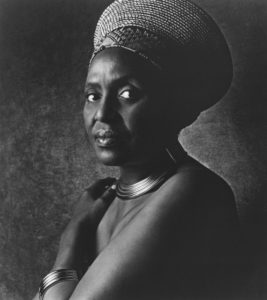
Lila Downs pour le Mexique ou Miriam Makeba pour l’Afrique du Sud, ainsi que dans les expérimentations du groupe slovène Laibach pour la Slovénie et dans l’électro-cumbia péruvienne de Dengue, Dengue, Dengue. Un grand mix alternant standards et titres méconnus, qui fonctionne comme un voyage étourdissant dans les musiques mondiales d’hier et aujourd’hui.
Myriam Makeba / ADHARA EVOO Afrique du Sud
Mais tout n’est évidemment pas si simple. En plus du critère géographique, Philippe Cohen Solal devait aussi combiner ses choix artistiques avec sa sensibilité de goûteur. Prenons ainsi la direction du Brésil, où il a sélectionné Terra de Caetano Veloso pour accompagner l’huile Terra Pampa, en raison du côté « végétal » qu’elle exhale ; ou Construção de Chico Buarque, pour « l’intensité extrême » de la Lagar H. En Italie, il a retenu deux titres d’Andrea Laszlo De Simone, auteur l’an dernier d’un superbe album pop (Immensità), en pensant aux huiles toscanes « entre tradition et modernité »de Marina Gioacchini, productrice de Le Amantine. Pour déguster les trois productions de la maison sicilienne Bona Furtuna, tenue par un couple américain de San Francisco, Philippe Cohen Solal suggère de réunir l’Italie et la musique anglo-saxonne en écoutant le twist Tu vuo fà l’Americano de Renato Carosone, le rock’n’roll Svalutation d’Adriano Celentano et Ragazzo Solo, Ragazza Sola, version italienne par David Bowie de son classique Space Oddity.
« J’ai voulu caser des morceaux plus électroniques, mais ça correspondait difficilement », observe Philippe Cohen Solal : « L’huile est une tradition rurale et ancienne qui se prête mal aux sonorités urbaines et futuristes. » Quand elle émane de Grèce (Melina Mercouri, Stravos Xarhakos, Dimitris Mitropanos, etc.) ou de Tunisie (Sidi Mansour, Anouar Brahem, Emel Mathlouthi, etc.), la sélection musicale est aussi copieuse que la production oléicole du pays concerné, tandis que l’on entend une version de Gnossienne N° 1 d’Erik Satie par le Turc Ergan Oğur, à déguster sur une Kisthene.
Gnossienne N° 1 d’Erik Satie par le Turc Ergan Oğur / KISTHENE Turquie
Vient l’huile « incroyable » du Japonais Toyohiro Takao qui place trois cuvées dans la liste : pour illustrer la “Frantoio” qui lui évoque « un jardin couvert de mousse », Philippe Cohen Solal a retenu Moss Garden de David Bowie ; pour la “Lucca”, « peu spectaculaire mais subtilement bonne », il a choisi le minimaliste Uoon II par Alva Noto et Ryuichi Sakamoto ; et pour la “Taggiasca”, il a pioché l’un de ses morceaux, Shizuka, une invitation au voyage interprétée par Maia Barouh et Mariam Tamari.
Moss Garden, David Bowie / TAKAO Frantoio Japon
Un autre de ses titres, Afro Bolero avec Angélique Kidjo et Mo Laudi, s’est glissé dans les playlists, où l’on retrouve forcément son emblématique Gotan Project, avec le tango mélancolique Érase una Vez, à écouter en savourant la Grand Laur “Cruz de Piedra”, évidemment une huile argentine.
Érase una Vez GOTAN PROJECT / Grand Laur “Cruz de Piedra Argentine